
The institution, located at the entrance to Limbé, preserves some of the oldest traces of the history of Haiti and the Caribbean linked to the Arawaks, the Taínos, as well as the Spanish colonists
At the entrance to the commune of Limbé, in the north of the country, a visibly deteriorated building, with cracked walls and no fence, stands along National Route No. 1.
Inside, dozens of precious artifacts dating back to the pre-Columbian period are displayed in precarious conditions, according to witnesses familiar with the situation contacted by AyiboPost.
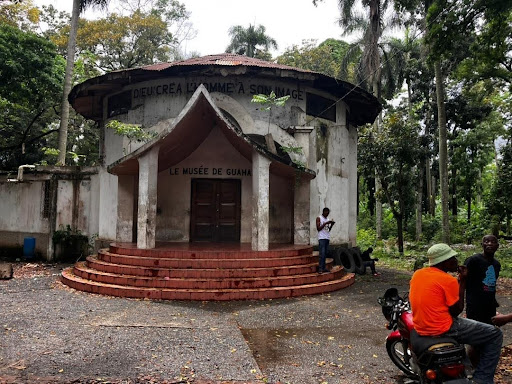
A look inside the Guahaba Museum in Limbé, in the Nord Department. | April 23, 2026. Photos: Eddy Pierre
For decades, the Guahaba Archaeological Museum preserved some of the oldest traces of the history of Haiti and the Caribbean, linked to the Arawaks, the Taínos, as well as the Spanish colonists.
But the site — closed for around three years after a long period of decline — is gradually deteriorating, while several revival attempts considered in recent years have never materialized.
The National Bureau of Ethnology (BNE), responsible for preserving this type of heritage property, says it attempted, up until last year, to intervene in order to recover the pieces still present on the site and revive the museum space.
But Erol Josué, director general of the BNE — an institution under the supervision of the Ministry of Culture — says he did not obtain authorization from the then Minister of Culture, Antoine Augustin.
Reached by AyiboPost, former minister Augustin denied the statement, adding that he had served as head of the ministry for only four months.
According to Josué, several other initiatives considered over the years to try to save the museum also remained dead letters.
In 2015, for example, former Minister of Culture Dithny Joan Raton, the BNE, as well as former Minister of Culture Eddy Lubin had considered creating an interpretation center dedicated to the Puerto Real site — where the excavations had taken place — as well as assuming responsibility for Guahaba.
The project was supposed to be developed with the support of a European agency, as part of scientific cooperation related to the archaeological site.
More than ten years later, the initiative has still not moved beyond the project stage.
Erol Josué attributes this failure to changes within the public administration, which gradually slowed the efforts undertaken around the museum.
Certain initiatives were recently taken by the Ministry of Culture to transfer several artifacts from Guahaba to the currency museum at the branch of the Bank of the Republic of Haiti in Cap-Haïtien, according to Erol Josué. However, the BNE was never officially involved in these efforts, says the institution’s director, who states that he cannot provide details about the intervention.
AyiboPost contacted the Ministry of Culture via E-mail. The institution had not responded at the time this article was published.
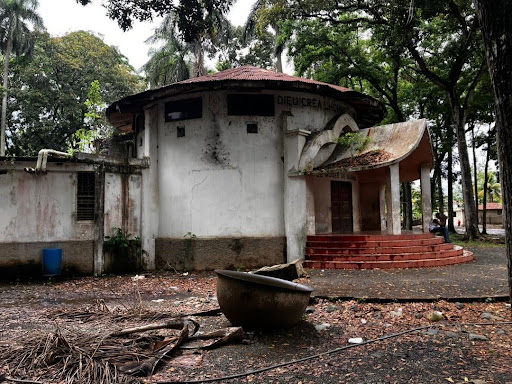
For Erol Josué, the gradual abandonment of the Guahaba Museum would lead to a form of “historical blindness.” “By continually losing these traces, an entire part of our understanding of the past risks disappearing,” the official warns.
This private museum constitutes one of the few regional spaces dedicated to preserving the remains of the first human occupations of Haitian territory, as well as the beginnings of the Spanish colonial presence on the island.
American medical missionary William Hodges created the space in 1983. Its rooms house dozens of artifacts, including ceramics, hunting tools, jewelry, stone mortars, ritual objects, and works of art.
The history of Guahaba originates in an almost accidental discovery.
The excavations that led to the museum began in 1975, when William Hodges, also founder of the Bon Samaritain Hospital, undertook research in the region in the hope of finding La Navidad, considered the first city built by Europeans in the Americas by Christopher Columbus after the wreck of the Santa María in 1492.
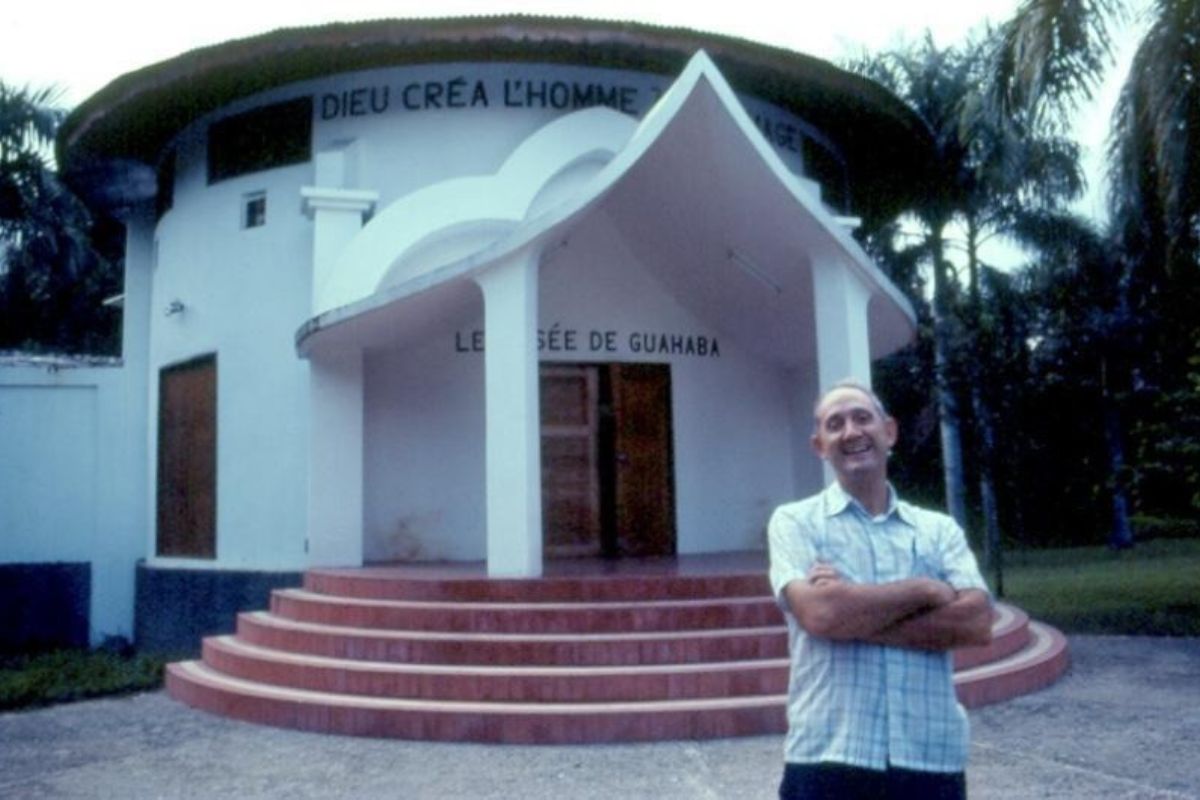
William Hodges posing in front of the Guahaba Museum in the late 1980s. Photos: Museum of Florida.
But instead of finding La Navidad, Hodges uncovered the ruins of Puerto Real, an ancient Spanish town buried beneath farmland near Limonade.
Quickly realizing the archaeological importance of the site, he contacted Charles Fairbanks, from the University of Florida, who agreed to join the research.
Between 1979 and 1986, several archaeological excavation campaigns were conducted at the Puerto Real site, one of the first fifteen Spanish towns founded on the island in 1503.
This research, carried out in collaboration with researchers, the Institute for the Preservation of National Heritage (ISPAN), and the Organization of American States, made it possible to excavate thousands of archaeological artifacts.
The Guahaba Museum was then created to preserve these remains.
“The artifacts discovered bear witness to the different phases in the evolution of our people, which shaped our identity,” says Eddy Lubin, anthropologist and former Minister of Culture.
At the end of the 1980s, the museum, then managed by officials from the Bon Samaritain Hospital, welcomed dozens of visitors every day, coming from several regions of the country as well as from abroad.
But this momentum quickly began to fade after the death of William Hodges in 1995, according to Eddy Lubin.
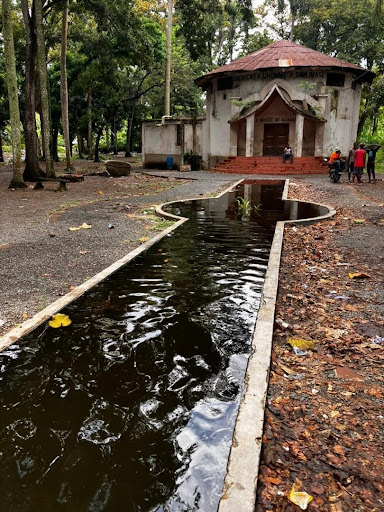
The large courtyard of the Guahaba Museum in Limbé. | April 23, 2026. Photos: Eddy Pierre
At that time, the anthropologist continues, excavation work at the Puerto Real site was suspended because of a lack of funding.
Over the course of the 2000s, the condition of the building gradually deteriorated. The roof began to leak.
Inside, some display cases containing the artifacts took on water during rainy periods.
“We did not have the means to carry out renovation work,” explains André Jeanty Pierre, guide, caretaker, and supervisor who watched over the museum almost alone for more than 25 years.
The 80-year-old man says he cannot rule out the possibility that some objects may also have been stolen.
According to him, despite its historical importance, the museum never benefited from sufficient resources to ensure its operation and maintenance.
The fee of 25 gourdes charged per visitor did not make it possible to ensure effective management of the space or to properly pay the staff.
To keep the site in condition, Pierre says he sometimes used his own financial resources to carry out certain repairs.
Pierre, who says he is now nostalgic, explained to AyiboPost that he accompanied generations of visitors before witnessing, powerless, the definitive closure of the site around three years ago.
Although he was never officially employed, he says he devoted a large part of his life to helping visitors discover the history hidden within the artifacts.
“I was placed there because of my closeness to William Hodges,” he recounts, emphasizing that the museum could receive up to 500 visitors per day during certain periods.
The situation of the Guahaba Museum is part of a context marked by a lack of local initiatives in the area of research and preservation of pre-Columbian archaeological heritage, three researchers emphasize in a study published in 2020 by the scientific publisher Multidisciplinary Digital Publishing Institute (MDPI).
A large portion of Haitian archaeological artifacts resulting from scientific excavations are still housed in foreign institutions — particularly in the United States — because of old research or temporary storage agreements that have sometimes been extended over time.
For example, more than 100,000 archaeological pieces collected between the 1980s and 2000s at the En Bas Saline site are currently preserved by the Florida Museum of Natural History under a cooperation agreement concluded between the University of Florida and the National Bureau of Ethnology.
Other major archaeological discoveries resulting from excavations carried out in 1983 at the site of the village of Guacanagaric, also in the north of the country, were later transferred to the University of Florida under an agreement concluded that same year with the Haitian state through ISPAN.
According to correspondence obtained by AyiboPost and exchanged at the time between the management of ISPAN and the University of Florida, these pieces were supposed to be returned as soon as an official request was made by the Haitian state. It remains unclear, however, whether the Haitian state has ever undertaken such steps.
According to the researchers in the study cited above, many important archaeological sites in the country are now threatened by looting, inappropriate occupation of spaces, land management practices, as well as natural risks.
In such a context of abandonment, many artifacts become targets for foreign traffickers.
In 2020, more than 400 archaeological pieces dating from the pre-Columbian period, illegally taken out of the country by an American during his trips to Haiti, were returned to Haitian authorities by the Federal Bureau of Investigation (FBI), through the National Bureau of Ethnology (BNE).
But preservation conditions nevertheless remain precarious.
According to Charité Joseph, who has headed the archaeological service of the BNE since 2011, the institution remains limited in its capacity to intervene despite the responsibilities entrusted to it regarding the preservation of archaeological heritage.
“There are things we would like to do, but cannot do, because certain actions are linked to state or government policies, which prevents us from acting,” the official explains.
According to Joseph, all archaeological and ethnographic property present on Haitian territory should fall directly under the institutions responsible for their protection and preservation.
Wethzer Piercin contributed to this report.
► AyiboPost is dedicated to providing accurate information. If you notice any mistake or error, please inform us at the following address : hey@ayibopost.com
Keep in touch with AyiboPost via:
► Our channel Telegram : Click here
►Notre Channel WhatsApp : Click here
►Our Community WhatsApp : Click here


Comments