
Haiti is living through an unprecedented humanitarian and security crisis. This is a five-week journey through its capital, the first city in the Americas to be governed by criminal gangs.
JUAN MARTÍNEZ D’AUBUISSON
This story is part of the project by Dromómanos and Global Initiative (GI-TOC) “The Fall of Port-au-Prince”
The body of a man they killed tonight is still smoking. Or what is left of him. At almost five in the morning on March 5, 2025, the students at the only school still opening its doors in the surrounding area walk along this street, so some women poured water over his remains before they were completely burned. Once the protection of the flames was gone, dogs and pigs ate his legs, arms, and head. Only the torso remains, wrapped in a kind of thick, long black hair: the wires inside the tires that accompanied him into the fire. We are standing in front of a street market in Delmas 95, a neighborhood in the Haitian capital of Port-au-Prince, the first city in the Americas to be governed by criminal gangs. We are inside the 10 percent of the city that has not yet fallen into the hands of Viv Ansanm, the largest confederation of gangsters ever seen on our continent.
The rays of sunlight slowly chase away the darkness, and women walk past the shapeless man. They cover their noses; the smell is strong, but none of them look directly at him. The market begins its activity, ignoring the dead man. The one thing that does not go unnoticed is my presence. A group of men on motorcycles begin watching us suspiciously. One of them shouts something in Creole and moves toward us carrying what looks like a chain. He does not want me to photograph the body. I only understand “blan” and “journaliste.” Ivander, my guide, believes they were the ones who killed him, or at least the ones who burned him.
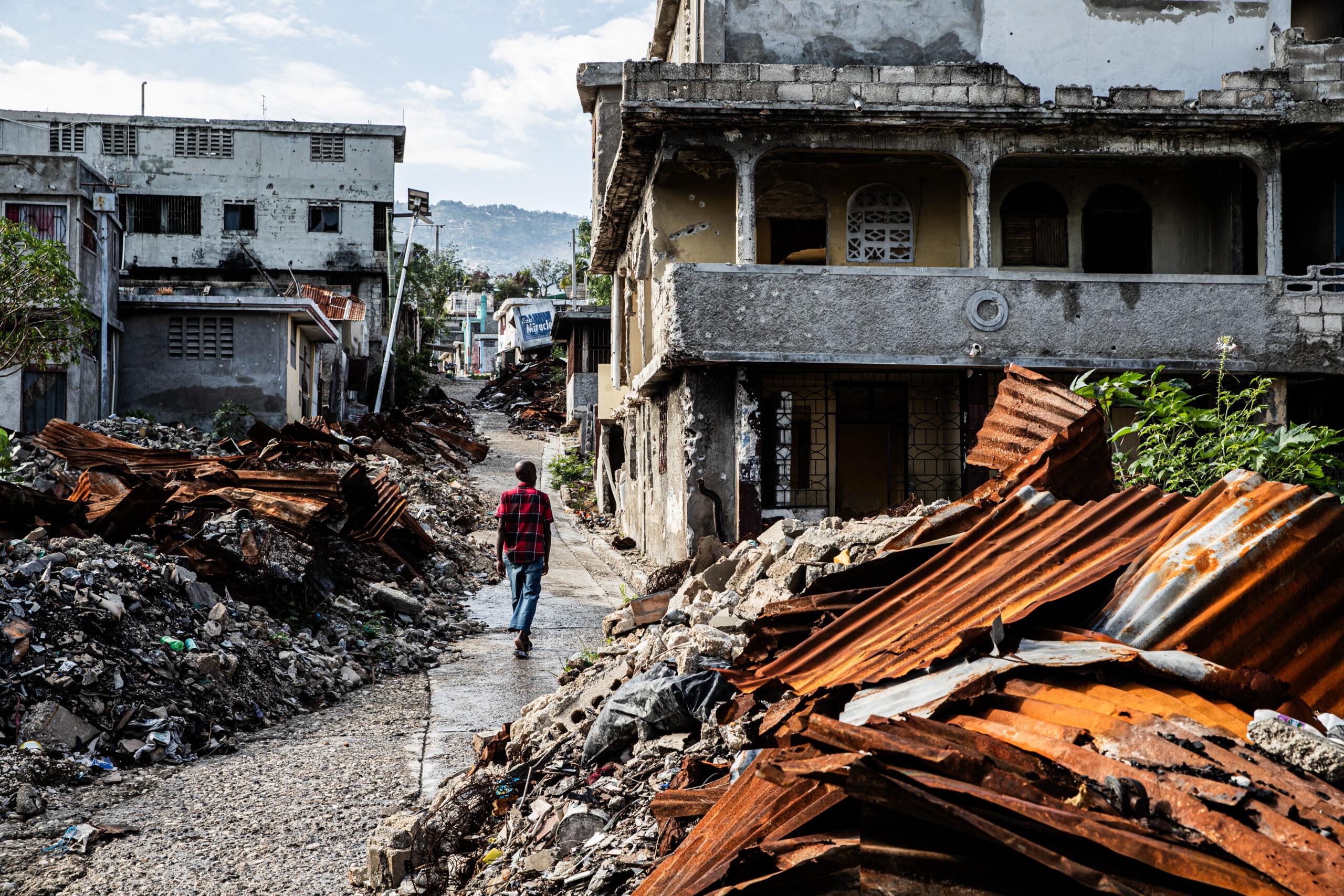
Debris is seen on February 17, 2026 in a street of the Solino neighborhood of Port-au-Prince, Haiti, which was attacked by gang fighters in late 2024. Photo : Clarens Siffroy / GI-TOC
A symphony of gunfire sounds a short distance away. The vendors look toward the sky, squint, and remain silent, making mental calculations about how far away the shots are. They go on with their business. The shots were not close enough to frighten them.
Ivander signals to me. We get on his motorcycle and head toward the corner of Rue 27, Bois Patate, in front of the small Tag Supermarket grocery store, which belonged to the Lebanese-origin Abraham family and now remains closed, blackened by so much fire.
“They’re burning another one over there,” he tells me.
“They always burn people at this hour.”
We pass within inches of a clean skull, matte black. Unlike the previous corpse, there is no flesh left here, only a perfect skeleton surrounded by that great cloak of black hair that was once the inside of the tires.
“We can’t stay here long,” Ivander tells me. “These people are very tough. This is Canapé Vert.”
He says it as though I should know the name.
More gunshots in the distance, gunshots all the time.
Canapé Vert used to be a middle-class neighborhood, with a lively cultural scene, small bars, cafés, businesses, and private schools. Several people who lived in and frequented the area before 2021, when the latest major wave of violence began after the assassination of then-President Jovenel Moïse, tell stories of spontaneous parties with DJs and afternoons in the central park drinking coffee and playing dominoes. It was considered a safe place in the middle of the chaos that was already Port-au-Prince.
Even today, Canapé Vert is home to many police officers, soldiers, and low-ranking government officials and their families. Amid the armed gangs’ offensive to control Port-au-Prince, police officer and warlord Samuel Joasil rose up here. He organized dozens of serving officers, former police officers, and neighbors into a small resistance army known as the Brigade.
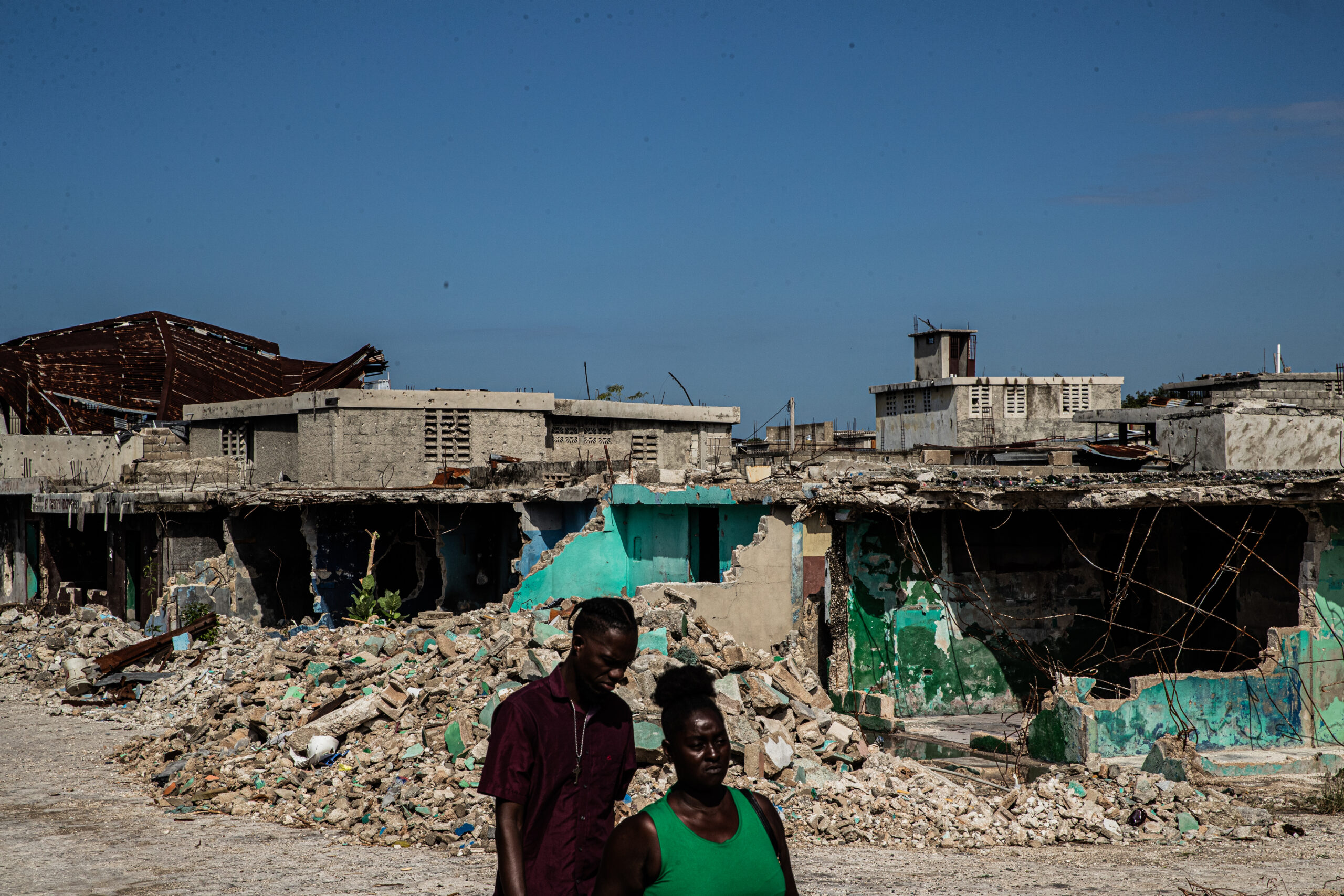
Houses destroyed by armed gangs in a street of the Solino neighborhood of Port-au-Prince, Haiti,on February 17, 2026 which was attacked by gang fighters in late 2024. Photo : Clarens Siffroy / GI-TOC
Canapé Vert, Samuel, and his Brigade became famous on April 17, 2023, when police detained 13 suspected members of the Kraze Barye gang (“The Barrier Breakers”), led by Vitel’Homme Innocent, the powerful warlord of the peripheral neighborhoods of Torcelle and Tabarre. According to the five witnesses I spoke with, the police searched for the passengers of a bus and found members of the group that were carrying firearms and ammunition. All the sources assumed they were preparing to launch an attack from inside Canapé Vert, a kind of Trojan horse, a strategy the gangs had already used to bring down other neighborhoods in the capital.
According to the police’s official version, once they were detained, a mob dragged them out of the station, hacked and stoned them, and, while they were still alive, placed old motorcycle and car tires around their necks and set them on fire with gasoline.
“You couldn’t even breathe because of the stench, and the smoke could be seen from the docks,” one of the people who took part in that massacre told me.
Amid the terror that had taken over the city, this brutal story became a symbol of hope: the neighborhood that defied the gangs and won, the people who erased the bandits from this world with the help of fire.
The people of Canapé Vert celebrated as the flames consumed the gang members. In a burst of euphoria, a man shouted toward a phone camera: “Bwa kale, Bwa kale!” An expression that literally means “erect and peeled penis,” but has a meaning beyond the literal. According to my sources, it would mean something like: “Fuck it all.”
Videos of the event circulated throughout Port-au-Prince and Haiti. The people of Canapé Vert placed piles of tires at street corners like a talisman, a reminder that it was better not to enter this neighborhood. Samuel Joasil won some battles and established contact and networks with the leaders of other strong neighborhoods who had also taken up arms against the bandits.
Almost every night, the clashes left a harvest of bodies. Between April and June of 2023 alone, according to the United Nations, at least 230 people were executed in Port-au-Prince. Burning them had to do, on one hand, with a public-health issue, and on the other, with a symbolic way of erasing them from the earth, reducing them to nothing. This fire became synonymous with salvation for some and with something terrifying for others.
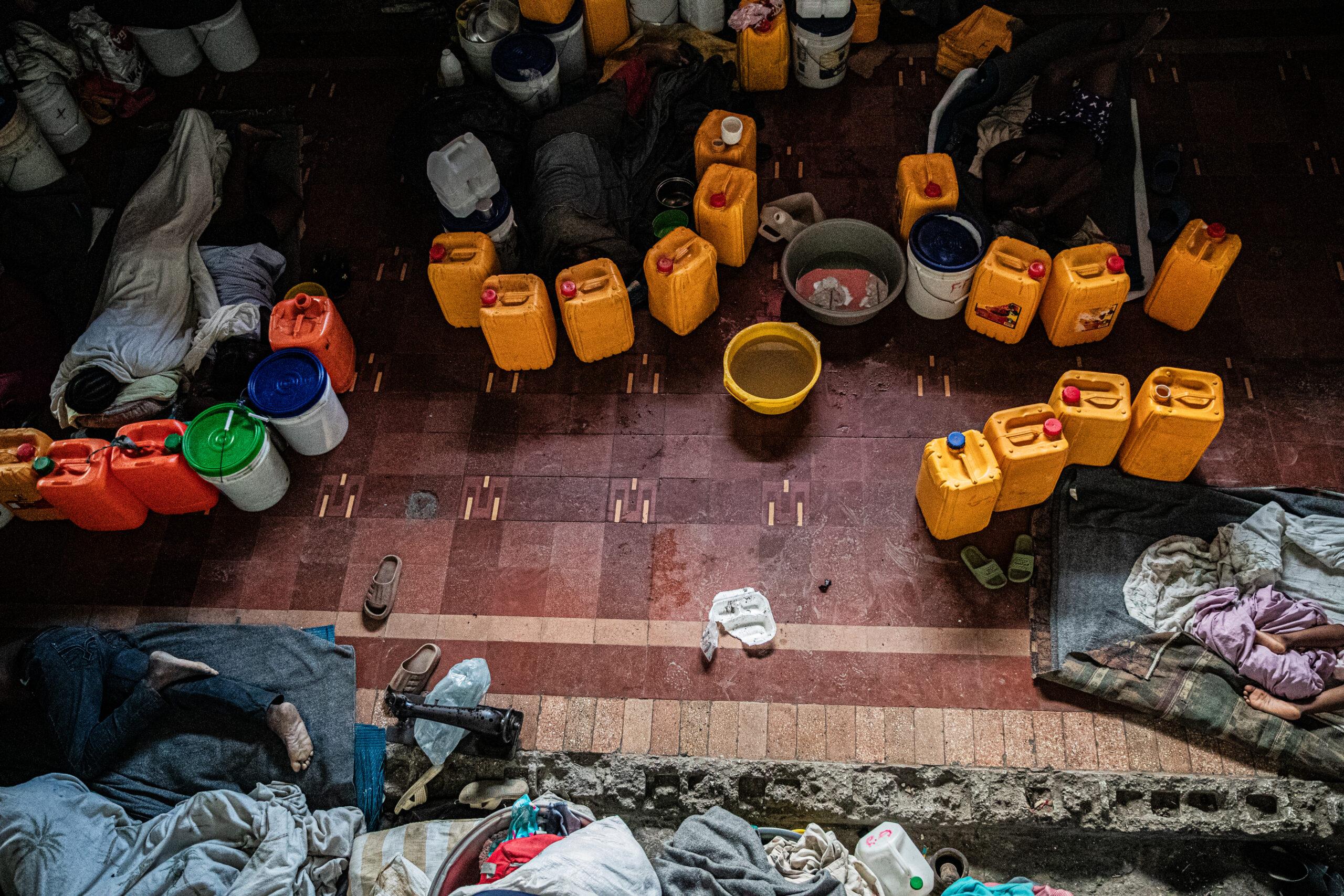
People shelter inside the Rex Theatre, which has been converted into a refuge for displaced individuals, in downtown Port-au-Prince, Haiti, on October 16, 2025. Photo : Clarens Siffroy / GI-TOC
By mid-2024, Samuel Joasil and his Brigade had been resisting for more than a year, and the war began to take its toll. Then came paranoia. From that moment on, in addition to defending the borders of this kind of fortress, they began looking inward, toward the refugees who arrived every morning before dawn seeking safety. If they could not give precise answers about their occupation, or said they came from somewhere and could not prove it, Bwa kale. If one of the thousands of refugees living inside the fortress pointed them out as a gangster or a gangster’s relative, Bwa kale. If the young men arriving were found with a weapon, ammunition, or something on their phones linking them to the gangs, Bwa kale. Or if one day a guard decided that someone looked like a gangster, Bwa kale.
During the five weeks I remained in Port-au-Prince, at least 15 people were burned alive or immediately after being killed in Canapé Vert. They all ended up in the same place: Rue 27, Bois Patate, in front of Tag Supermarket, which belonged to the Abraham family. They all ended up wrapped in a long black mane.
I came to Port-au-Prince because a man whom we will call Monsieur X, to protect his identity, made me an offer I could not refuse: “We are going to kill the most important leader of the Viv Ansanm bandits with drones. There will be no other foreign journalists in the city; they are afraid to come. You will be the only one,” this man, a political operator on the Transitional Presidential Council, the body that exercised executive power in Haiti until February 7, told me. I suppose Monsieur X and his circle were interested in showing the bandit leader the way Colombian police had once shown the body of Pablo Escobar: sprawled out, bleeding, barefoot, defeated. I suppose I was not their first choice, but I was the one who accepted. Perhaps I should have thought it through more carefully.
To get here, I had to fly on twin-engine planes and light aircraft all over the Caribbean, across large islands such as Nassau, in the Bahamas archipelago, and small Antilles such as the Turks and Caicos Islands, until I reached Cap-Haïtien, or Cap Haitien, a city that is devastated and desperately poor by any Latin American standard, but considered a city and an oasis of peace in Haiti. There I waited for a week in a damp room in a noisy hotel where the shower poured seawater, until my contact told me to go outside, that a vehicle was waiting to take me to the airport and board the “Civil Protection” helicopter that would take me to the capital. After an hour flying over endless desolate hills and rocky plains, I landed in Port-au-Prince.
The city received me with hostility. The night before, Viv Ansanm gangs had attacked a neighborhood in the Delmas area, near the airport, and columns of smoke from burning houses rose into the sky like gaseous buildings on the verge of collapse. I arrived late. By February 25, 2025, almost everything that turns a piece of the world into a city had been destroyed here.
The city is already dead. Viv Ansanm killed it.
Port-au-Prince lost the functioning of its airport, Toussaint Louverture, in November 2024—after it had already been closed for a year—when the gangs opened fire on planes belonging to Spirit Airlines, JetBlue, and American Airlines, wounding a flight attendant. All the other airlines fled like frightened birds. Only military aircraft land here, bringing some vehicles and police officers to support the Haitian government, and the Civil Protection helicopter on which I travel.
A few months earlier, the city had also lost much of its ports and docks. They now belong to Viv Ansanm. Sylvio Cator football stadium is a ruin, and four of the five public hospitals were destroyed, leaving only Hôpital Universitaire La Paix partially functioning. Dozens of police officers and at least five journalists have been killed in this onslaught. Seven police stations were razed, some demolished down to their foundations with tractors or burned to the ground, and dozens more were damaged in attacks.
The roads are controlled; the markets open intermittently depending on the gangs’ siege. Many of the schools and institutes that were not burned are now refugee camps, receiving dozens of families every morning before dawn after they lost their neighborhoods overnight to the gangs’ fire. Port-au-Prince has lost every single one of its exits. No one calls them entrances anymore.
Not even the dead, who are everywhere, can be buried in peace. The gangs control the city’s four cemeteries, including the historic Grand Cimetière, where until four years ago the colorful, boisterous celebrations of the guédes were held, where the place filled with life and people ate and danced. Now all that remains there is death, and people must pay the gangs to put a relative underground.
The government center, whose surroundings were overflowing with vendors, pedestrians, street performances, and life barely four years ago, now has room only for war. On my first day of fieldwork, I wanted to see the vestiges of the city’s heart. It is called Fort National; from here the Haitian state was administered before Viv Ansanm began administering the capital.
Under a shadow, on the sidewalk, an old woman is dying. She already looks like a corpse that breathes. Beside her, a younger woman prepares a little rice over a stove made from garbage. I ask her about the old woman and she only knows that she arrived a few nights earlier in the middle of a storm, sitting in a wheelchair pushed by someone who fled while Viv Ansanm attacked one of the settlements in Kenscoff, in the mountains surrounding the Haitian capital. She became sick and stopped eating. She does not know her name. She stays beside her because a tree mercifully shields this same patch of asphalt from the sun.
About 30 meters away, almost opposite the ruins of what used to be the Rex National Theater, a man of indeterminate age raises his arms and surrenders. He does not seem to know to whom, but he surrenders. He lifts his shirt to show those attackers, who threaten him from inside his head, that he is not armed, that he is not a danger. He shouts something at me in Creole; it sounds like a plea. Then he continued his way. He is going somewhere else to surrender.
The soundtrack of this city—the gunshots—grow louder, closer. People’s faces change. Their bodies become alert; they move; they run. I tell Ivander to get me out of there. We climb onto his motorcycle and flee in the opposite direction from the gunfire.
Tomorrow I will return to the same sidewalk, and the old woman will still be there, with her expression of death on her face, her mouth open, her eyes closed, breathing slowly like the swell of the sea. The day after tomorrow, she will be gone.
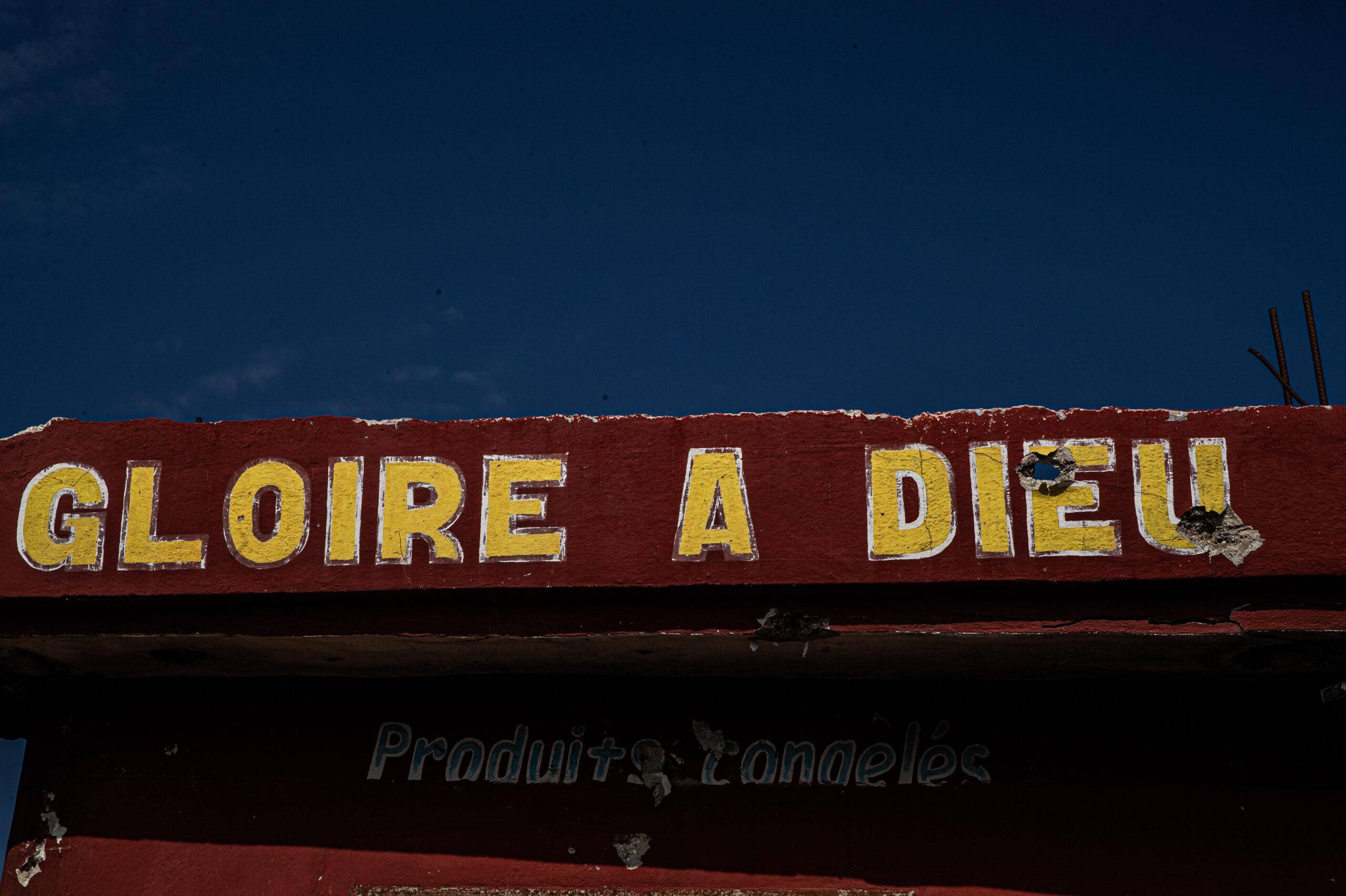
A shop smashed with projectiles from armed gangs, « Glory to God » written on the wall.in Solino,Port-au-Prince, Haiti,on February 17, 2026. Photo : Clarens Siffroy / GI-TOC
This death of Port-au-Prince that still has not ended officially began in the early hours of July 7, 2021, with the assassination of a man, President Jovenel Moïse, but it began many years earlier. Even before the terrifying dictatorship of François Duvalier, the tyrant and Vodou priest who terrorized the country from 1957 until his death in 1971, when his son replaced him for another 15 years. Perhaps before 1811, when Henri Christophe, the first Haitian president after independence, declared himself emperor, oppressed his own “subjects,” and ended up shooting himself with a golden gun before falling onto a bed of fresh cement. Perhaps before the great pact between France, England, and the United States in the nineteenth century to marginalize the first nation of freed Black people, the second independence of the Americas. Perhaps Haiti has never stopped dying, dying a slow and painful death since it was born, since those enslaved people conquered their freedom with machetes, until today, when, as nowhere else in the continent, Port-au-Prince has been taken over by gangs and criminal groups that have displaced the state. The history of this city is the great parable of what happens when violence is given completely free rein.
Specialists, ethnographic observation, journalistic records, and the available literature on the criminal groups that seized power in Port-au-Prince point to three things: Haitian gangs have been created, financed, and armed by different political factions in the capital for decades. We can say that the president’s death in 2021 broke the fragile balances in the political arena, and that the bandits, tired of fighting among themselves to serve their patrons, saw an opportunity to take the city. The third point is that the violent structures of Port-au-Prince almost all have an intimate relationship with the religious world of Vodou, the historic religion of African origin with the largest following in Haiti, whether as a genuine expression of religious belief, as a form of legitimization before the population, or even as another form of domination over the populations they seek to subjugate.
We can say, moreover, no longer in an attempt to taxonomically categorize the gangs but rather as an aggravating factor in the violence, that no institution, neither state nor international, has shown the strength or genuine interest needed to stop this great death looming over Port-au-Prince.
What is happening in Haiti’s capital can be defined as a “poly-conflict” or, if we want the boring, academic, labyrinthine version of the matter, a “politically and territorially rooted, multi-front conflict involving diverse interests.”
Two years ago, the great gang federations of Port-au-Prince stopped that kind of “serious game” of reciprocal aggression, similar to that of the Central American maras or African American gangs in California, that exchange of street insults and offenses that kept them constantly under fire and at the service of politicians and businessmen. On that historic February 29, 2024, the bandits of Port-au-Prince stopped pointing their guns at one another and pointed them together at everyone else.
As an introduction to some of the more than one hundred armed groups that make up Viv Ansanm, I should warn that the Haitian gangs and gangsters that make up this great criminal alliance are each more tropical than the last, and the internal structure of these groups almost always revolves around the figure of a warlord or strongman, whose characteristics seem, over time, to come to define the group itself.
In northeastern Port-au-Prince, in the town of Croix-des-Bouquets, there is Wilson Joseph, known in Haiti as Lanmò San Jou (“Death Without a Day”), who, besides commanding the 400 Mawozo (“the 400 brutes, rustics, or hicks”), one of the country’s most important armed forces, presents himself as a bokó, or Vodou priest. He is also one of the main suspects in the kidnapping of 16 American missionaries and one Canadian in 2021.
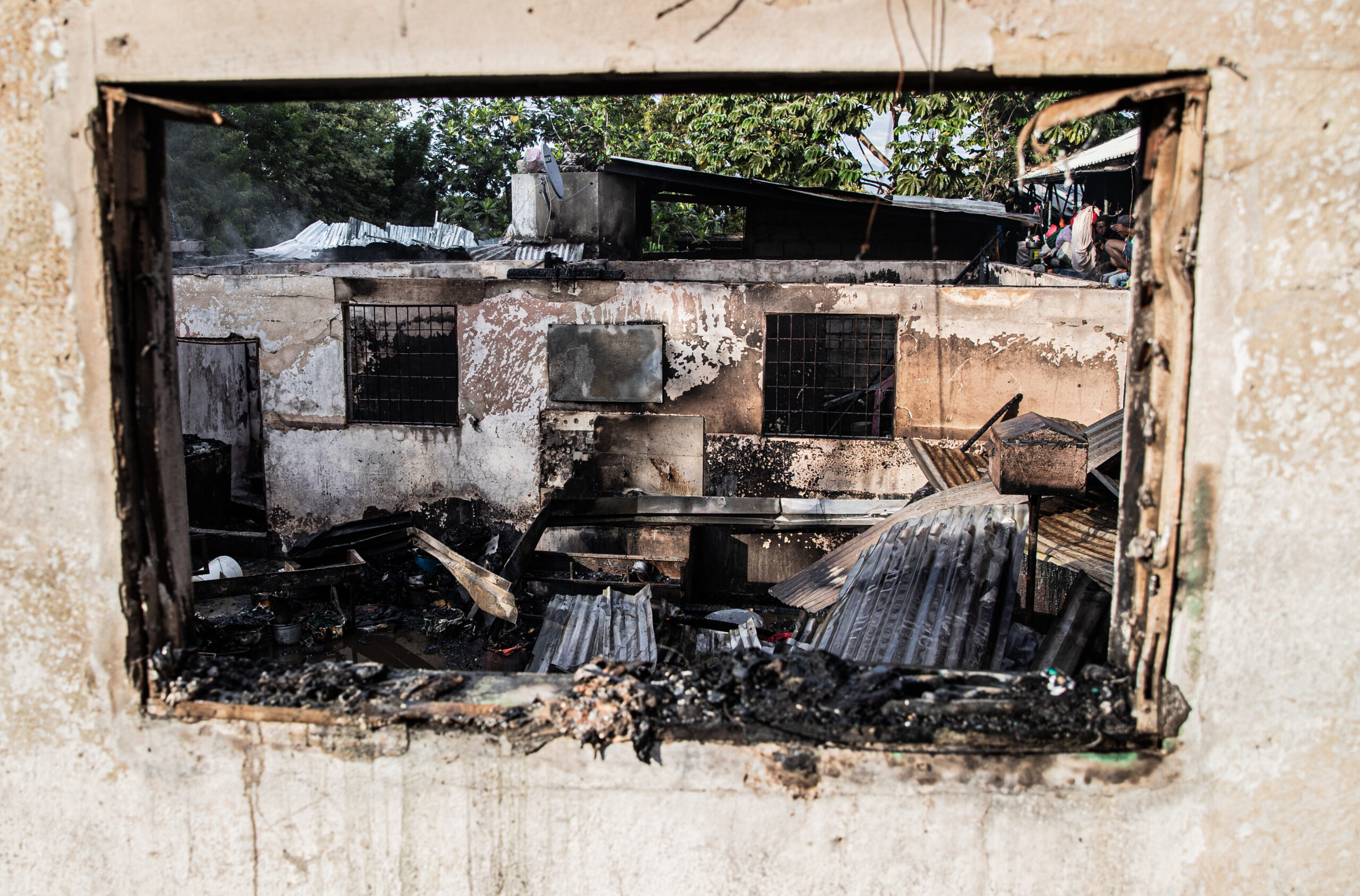
View of a displaced persons camp that was burned down in the city center,in Port-au-Prince,Haiti,on December 21,2025. Photo : Clarens Siffroy / GI-TOC
There is also the warlord Kaporal Ti Lapli, leader of Grand Ravine in the neighborhood of the same name, who portrays himself as a revolutionary leader and, as proof of his supposed social commitment, is building a hospital in his territory.
Then there is King Micanor, lord of Wharf Jérémie, the port through which many of the products enter and leave the capital. In December 2024, he perpetrated one of the largest massacres of recent decades, killing more than 207 people in retaliation for the death of his youngest son, who, according to Micanor, became ill because of Vodou.
Manno, lord of Village de Dieu, and his lieutenant Izo 5 Segond, leader of the 5 Segond gang, also joined. The latter, besides ruling his territory, boasts of being a rapper and uploads his songs and videos to social media.
From the neighborhoods on the outskirts of the capital came Vitel’Homme Innocent, lord of Kraze Barye (“Barrier Breakers”), a warlord feared throughout the capital and on the FBI’s list of the ten most wanted men from 2023 to 2025, and behind them comes a very long list of warlords and their small armies with fantastic names. All men, all armed, all with the goal of winning for themselves what they had spent decades winning for others.
The man who has presented himself as the public face of this grand understanding is Jimmy Chérizier, a 46-year-old former police chief accused of perpetrating massacres and political killings since 2018. This man took on the task of bringing together the leaders of the city’s main armed gangs and, in an unusual exercise in the world of bandits, proposed leaving behind the bloodshed and the offenses they had suffered, as long as everyone was willing to forget. They were.
This man is called “Barbecue,” and his numerous forces were known as the G9 and Family, which controls much of the enormous Delmas neighborhood in the center of the city. This is the man Monsieur X intended to assassinate with his drones, whose remains I was supposed to photograph.
The criminal gang leaders decided to suspend their fighting, maintain autonomy in their territories, and fight with a single objective: to take the city. This time the bandits abandoned their tropical names to baptize this great confederation with a sober name, one that contains terrible irony. Viv Ansanm, the criminal coalition that has unleashed war and sown death throughout Port-au-Prince, means “Living Together.”
Since its birth, Viv Ansanm has stormed prisons to free its members, attacked every representation of the weak Haitian state, and through fire and gunfire has managed to control 90 percent of Port-au-Prince.
The city I encounter is a city of ghosts. One of the problems for Barbecue and Viv Ansanm is that one of these ghosts is Samuel Joasil. This man and his small, improvised army have decided that they will resist, that they will not allow Viv Ansanm into their fortress, and to a great extent they resist because Samuel Joasil has a weapon. It is something powerful, something that makes the bandits hesitate, and whose mere mention generates terror even inside the fortress: Bwa kale.
From the roof of a burned-out car, a hooded man points a shotgun at passersby. He is young; you can see it in his hands, in his feline movements, in his wiry body. About two meters away, from the roof of another car skeleton, another man, older and with a belly, is also keeping watch, carrying a machete and a spiked bat. Last night Viv Ansanm bit into one of the settlements of Kenscoff, in the neighborhoods surrounding the fortress, and those who survived and fled here still carry the tragedy on their faces. That is why the resistance leader, Samuel Joasil, has ordered a total lockdown, and his brigades spread through the main streets like packs of rabid wolves protecting their den.
Traffic is chaotic. There is no order whatsoever regarding the direction of the streets, and there seems to be no agreement about the difference between a street and a sidewalk. The armored vehicles of officials and the few foreigners from the United Nations and multilateral organizations who have not yet evacuated the city honk and sound their sirens in an attempt to scare away cars, motorcycles, and people, but it is useless.
It is March 15, and after three weeks in the city I asked Ivander, my guide, to take me to the borders. I want to know the frontier between Samuel Joacil’s fortress and the dead territory of Viv Ansanm.
Amid the disorder, we reach Delmas, an enormous neighborhood. Delmas 32 fell last week, and the border has therefore shifted; the fortress has grown smaller and is filling with more refugees from the neighborhoods Viv Ansanm is swallowing. Overcrowding turns into garbage and stench.
A year ago, the fortress was twice as large, and the brigades defending it were much stronger and more numerous. Less than a year ago the fortress did not begin in Canapé Vert. It began in Solino, a tough neighborhood that fought to the end and has become both legend and parable.
Solino was a strong neighborhood, defended with weapons by its inhabitants, a Canapé Vert before Canapé Vert. Solino’s defense was organized by a police officer, Jeff Petit-Dieu. Solino was strategic: from there, the center could be taken, and it was the road to the current fortress. It was a gateway and a drawbridge. In late November 2024, Viv Ansanm sent in gang members disguised as refugees and attacked from inside and outside. After that Trojan horse, the neighborhood fought, the neighborhood lost, and the body of the great leader Jeff Petit-Dieu had to be recovered in an assault coordinated by Samuel Joasil, his men, and what remained of Solino’s army.
“Canapé Vert is not Solino.”
Samuel Joasil’s men shout it at the checkpoints.
“Canapé Vert is not Solino.”
It has become the battle cry of those who inhabit the living part of this corpse.
The bandits believed that if Solino fell, the rest of Port-au-Prince would fall. But there stood Samuel Joasil, his brigade, and his Bwa kale. Since then, Canapé Vert has become the engine of resistance and a priority target for the bandit leader Barbecue and Viv Ansanm. Around it are parts of Delmas and the areas of Pétion-Ville, Bourdon, Debussy, and Juvenat. This is the fortress, much of the famous 10 percent mentioned in United Nations reports, where those who inhabit the corpse of Port-au-Prince resist.
“This is the border. From here onward, it’s the bandits’ territory,” Ivander tells me in his Frenchified, Caribbean Spanish.
There is no wall, but it is as though there were. An invisible barrier separates traffic and bustle from nothingness and silence. The street ends abruptly, without the need for a sign. I stop directly on the imaginary line and take video and photographs. In the distance, in that desert, a lone car stops, reverses, and a man inside points something at me. Ivander shouts at me to move away. People take cover, waiting for the shot. I take shelter. It is time to move.
Today the fortress is growing its thorns to keep Viv Ansanm’s forces out. Every block has been closed off with metal gates or burned-out cars. Those who have none of these things resort to the ultimate symbol of resistance: piles of burning tires.
The directive Samuel Joasil has given is to make it difficult for the enemy to move, forcing them to advance slowly and on foot so that the men of his Brigade can hunt them down. But everyone interprets this as best they can, and in the face of the threat, every block of the fortress armors itself, making movement impossible even for those who live inside.
As we try to climb toward Pétion-Ville, the place inside the fortress where I am staying these weeks and where Ivander lives, we come across a group of hooded men and their improvised checkpoint. A young man points the tip of his machete at us and tells us to pull over to the side. It is my first encounter with the Brigade. It will not be my last.
Three men approach us. Only one has his face uncovered and appears to be the leader. They tap our hips gently with the machete, looking for the metallic sound of a weapon. Beside us, at least 20 young men wait their turn to be searched. Fear spills from their eyes. I identify myself as a journalist. They do not care, but they find nothing incriminating on us. The checkpoint leader comes toward us, looks at me in disbelief, and scolds Ivander: “Get this journalist out of here! Are you crazy? Things are going to get ugly,” he tells him in Creole, in the tone soldiers use when giving orders.
It seems today is not a good day to see the border, but here it is almost never a good day for anything.
Ivander uses his shortcuts, riding through alleys that were not designed for motorcycles and perhaps barely for human beings, and we climb toward the fortress. Viv Ansanm is close. Along the way we pass the corner of Rue 27, Bois Patate, in front of Tag Supermarket, the corner of Bwa kale that the tragicomic humor of Haitians has christened the kitchen.
On March 15, another person burns in the middle of some old tires in the kitchen. She was killed that morning. The fire has stripped this corpse of everything surrounding the bones, and they seem to rest there, calm and brittle, wrapped in their black mane. She was a woman, according to Ivander. She was caught that very morning, and she was a refugee from who knows which neighborhood. My sources will tell me that apparently, she was carrying an unusual amount of money in her basket. A young man from the brigade said that was suspicious; another said the gangsters move money through women so as not to raise suspicion. A third said he thought he had seen her once with a gangster in a photograph. They all agreed on one thing: Bwa kale.
They slit her throat and, while she was still alive, took her to the kitchen, in front of the desolate business belonging to the Abraham family, and burned her. In a couple of hours, she will be almost completely consumed. Soon that woman will become a dark stain on the pavement and fly as a dark cloud across the sky of Port-au-Prince, and over her carbon-black stain the fire will later consume others.
A Corpse That Still DancesA Corpse Still Dances
On the rooftop of the Hotel Karibe, a line of flames has been lit along a sushi bar. White men sit down on the barstools and order colorful drinks, with olives inside and served in long, baroque glasses. It is the end of an afternoon in mid-March, and some officials from IOM, the UN, and UNDP come up to the bar, at the top of the hotel, one of the few still operating in the city and an iconic place for Haiti’s upper class. What remains of Port-au-Prince’s oligarchy also gathers here. They are mostly men, some of Palestinian and Lebanese descent, whose families arrived as merchants in the middle of the twentieth century and became a powerful elite. But there is also a purely Haitian, or “Creole,” elite tied to politics and large national businesses.
Around eight in the evening, a group of young women enters the rooftop. They are all Black and slender, wearing very short dresses in garish colors. The white men at the cocktail bar stare at them openly and comment on them, arguing over which one is the prettiest. The women give them smiles and flirtatious movements. One of those enchantments that belong to the night takes place there, and the bar slowly transforms into a party.
The Hotel Karibe is in Pétion-Ville, the neighborhood that is home to a handful of wealthy families and has been considered the least unsafe place in the capital since 2021. This is where we find the things we usually associate with the elite: gourmet restaurants, beauty salons, clothing stores, and coffee shops. But poverty, in the poorest country in the Americas, seeps everywhere.
Pétion-Ville is also home to dozens of desperately poor settlements clinging to the hillsides, looking as though they could slide down the slopes at any moment. It is surrounded by the resistance and has become the bureaucratic center of the fortress. Meetings between authorities are held at the Hotel Karibe; against all logic, business continues, and nonperishable goods, beer, clothing, vehicles, perfumes, refrigerators, air conditioners… continue to enter. Many of the officials from international organizations still in the city also live in this hotel.
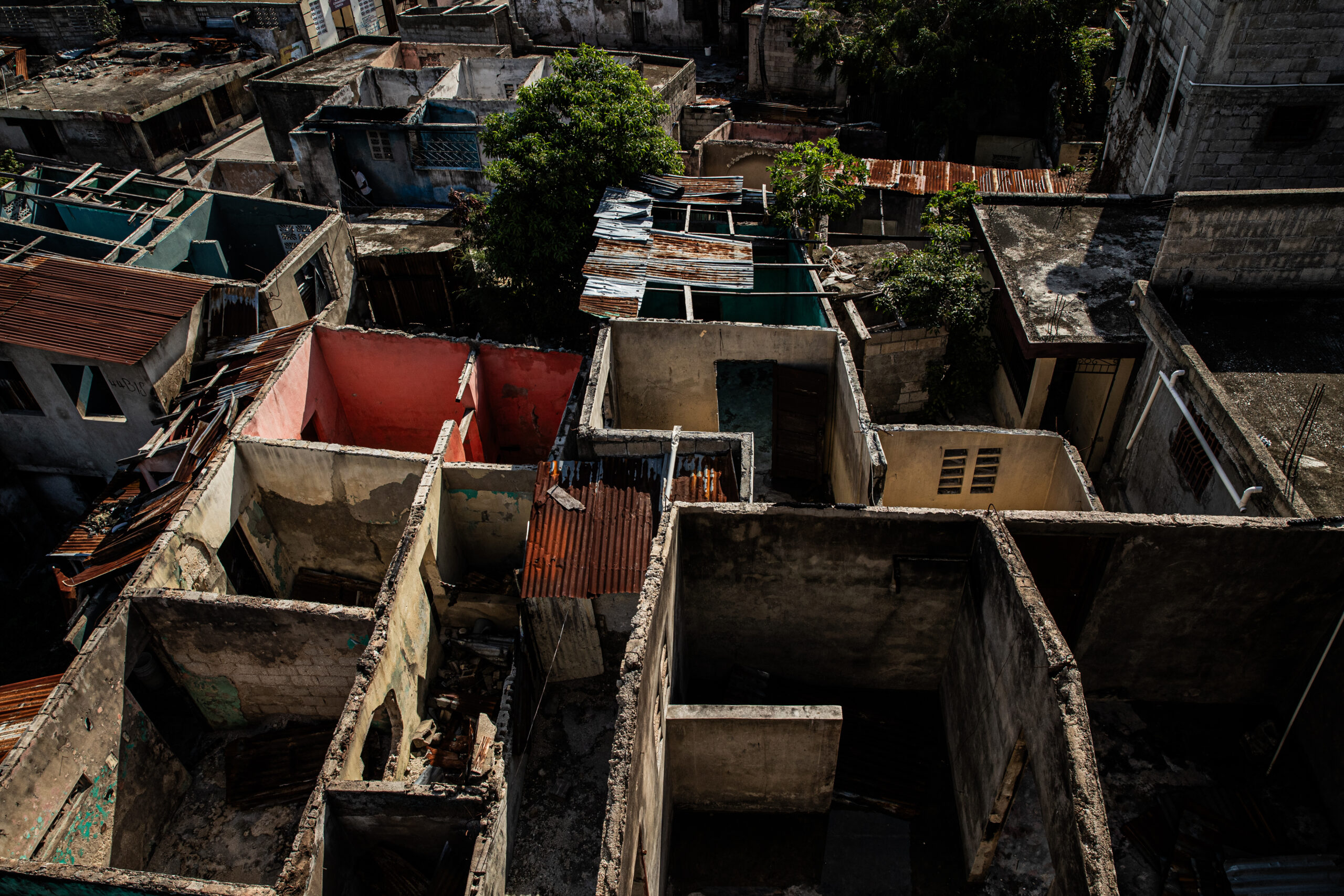
Houses destroyed by armed gangs in a street of the Solino neighborhood of Port-au-Prince, Haiti,on February 17, 2026 which was attacked by gang fighters in late 2024. Photo : Clarens Siffroy / GI-TOC
In 2023, faced with the urgency of the humanitarian disaster bearing down on Port-au-Prince, the United Nations designed a support mission led by the Kenyan police. The mission’s objective was to assist the Haitian police in controlling the gangs and protecting the infrastructure necessary for the state to continue operating. To that end, Kenya has sent several contingents totaling around 1,000 personnel. Nine other countries have joined the operation: Jamaica, the Bahamas, El Salvador, Guatemala, Belize (2 soldiers); Bangladesh (has promised to send soldiers); Chad (commitment pending); Guinea (commitment pending); and Benin (promised 2,000 soldiers). It sounds like a list of countries that need military assistance, not countries that can provide it.
The international community is betting on these soldiers and police officers from the Global South. For the vast majority of people in the fortress, the answer lies with Samuel Joasin, the Canapé Vert Brigade, and Bwa kale.
The barbarity outside does not enter the Karibe, nor its swimming pool, nor its tennis court, nor its rooftop.
This Saturday night is oppressive with heat, and the girls in colorful dresses turn the rooftop into a dance floor. The DJ turns up the volume when I Gotta Feeling, by The Black Eyed Peas, comes on, and the young people are possessed by euphoria. Drinks pour out of the bar in massive, bubbling quantities, and the bartenders cannot keep up. The night promises something, but at one point the DJ makes a beginner’s mistake and cuts the music, or perhaps there is an electrical failure, or a cable comes unplugged. Then the city speaks to us.
We hear a symphony of bursts of gunfire, explosions, screams, and packs of dogs barking and howling. Viv Ansanm has descended upon the hillsides that were left outside the fortress. The brigade is fighting, but it seems to be losing. On the rooftop, a woman’s scream rises above all the noise, but I cannot understand what she is saying. She sounds distraught. Whatever she has lost has hurt her deeply. Two of the girls hold hands, and one closes her eyes; another covers her ears. The white men at the bar discuss it the way one might discuss a soccer match. The bartenders and waiters freeze and look down. The façade of that magic dissolves. But the connection comes back, or the cable has been plugged in, and the DJ summons Taylor Swift to bring the spell back, to silence the sonic tragedy that threatened to spoil the night. The drinks keep circulating, the girls keep dancing, the white men continue with their monotonous apathy. Outside, in the hills, those people continue losing, but here no one can hear them anymore.
The drone attack planned in great secrecy, which was what originally brought me to Port-au-Prince, took place on March 7. The night before, I received messages from Monsieur X warning me to be ready for “something important.” The news spread through the city like fire. A group of police officers under the orders of Prime Minister Alix Didier Fils-Aimé, known as the Task Force, launched several bomb-carrying drones at Jimmy Chérizier, Barbecue, in the Viv Ansanm-controlled sector of Delmas 6. It was a failure.
A few hours later, Barbecue uploaded a video to his social media, shouting and showing the remains of a drone. He said they had barely managed to injure him. It was a fiasco, an expensive and poorly planned operation. No one could produce an important corpse, and the plan of these people to show me the capo’s head exclusively, as a hunting trophy, went up in smoke. I suppose the shame kept them from answering my calls again. From that day on, I was stranded in Port-au-Prince.
Viv Ansanm’s attacks intensified. Barbecue kept his threats. In the past two weeks, dozens of neighborhoods in the Kenscoff and Carrefour-Feuilles areas, on the poorest edges of the fortress, have come under attack at night. Isolated shots became bursts of gunfire, and fires illuminated the hills.
Ivander, my guide, has devised a plan to smuggle his daughters out of the city hidden among the sacks of one of the few trucks still entering and leaving the city, bound for the port city of Jacmel, to save them. But the city’s exits are controlled, and Viv Ansanm’s men inspect every vehicle, charging a toll and making sure people remain inside the trap they have turned the city into.
“I’m staying with my son and my wife. We can fight or run, but the girls can’t,” he told me one midday as we went to pick up the little ones at one of the very few schools still operating inside the fortress.
In recent days, the entrances to the fortress have remained closed, and the Brigade’s instruction is for people to prepare to fight. If the bandits take the fortress, there will be nowhere else to run. Those who ran here for refuge are packed into parks and abandoned schools that exceeded their capacity long ago. The kitchen is operating at full capacity.
When everything seems lost, the resistance decides to make a dramatic move.
Samuel Joasil and his lieutenants order the Brigade, together with the population of the fortress, to seize Fort National in the center of the city. That is when I realized that Ivander, my guide, is part of the Brigade. He is a community leader, and he is planning to go with his people and join the uprising. He invites me to come. I accept. I should not have.
On March 19, we descend with a group of men and women from the heights of Pétion-Ville down the slope of Debussy, which connects to Canapé Vert, where Samuel Joasil has summoned thousands of people to take the city center. We have to walk; there are checkpoints every hundred meters, and people have erected barricades in chaotic order.
The day before, I accompanied Ivander to buy machetes at the Pétion-Ville market, where several pickup trucks parked with their beds loaded with them, and people carried them away like bread. Everyone is armed except me. Those who do not carry a shotgun or a homemade weapon carry machetes; those who could not get one carry bottles filled with nails; and then there are the last ones, those carrying the weapons of the Davids: stones.
If we go by technical definitions, these people are not planning a peaceful protest, nor a violent one. These people are going to stage an uprising.
“Canapé Vert is not Solino!” They shout, referring to Port-au-Prince’s parable of a neighborhood, waving tree branches they have cut along the way.
“Yo p ap pase!” hundreds of people shout in unison, enraged. “They will not pass!”
It is nine in the morning and we are late. The bulk of the crowd has already left Canapé Vert, surrounding Samuel Joasil and his lieutenants. We will be the tail end. We walk with Ivander’s group for about half an hour, crossing barricades and checkpoints until we reach the center of Canapé Vert.
Then it happens.
A man looks at me and seems to find something aberrant in my presence. “No blan!” I manage to make out amid his shouting. “No journaliste!” He screams, and the veins in his neck swell. Unfortunately for me, I am both. Ivander tells me to keep walking, not to look at him, but then two others join him. They shout at me, but they do not approach. We keep moving. Ivander does not look worried. He is a big man. He is a community leader.
We reach the exact place where that first Bwa kale began, where those 13 men were roasted alive in April 2023. The ground is stained with soot, and there are still traces of that black metallic fur embedded in the pavement. Then there is an explosion and people run. It is a stampede. I cannot tell whether it was a shot fired at the crowd or someone in the crowd detonated a homemade bomb, but everyone runs.
We run too, but without realizing it we become surrounded by a large group of men who, once the urgency of getting away from the explosion has passed, focus on me and begin shouting.
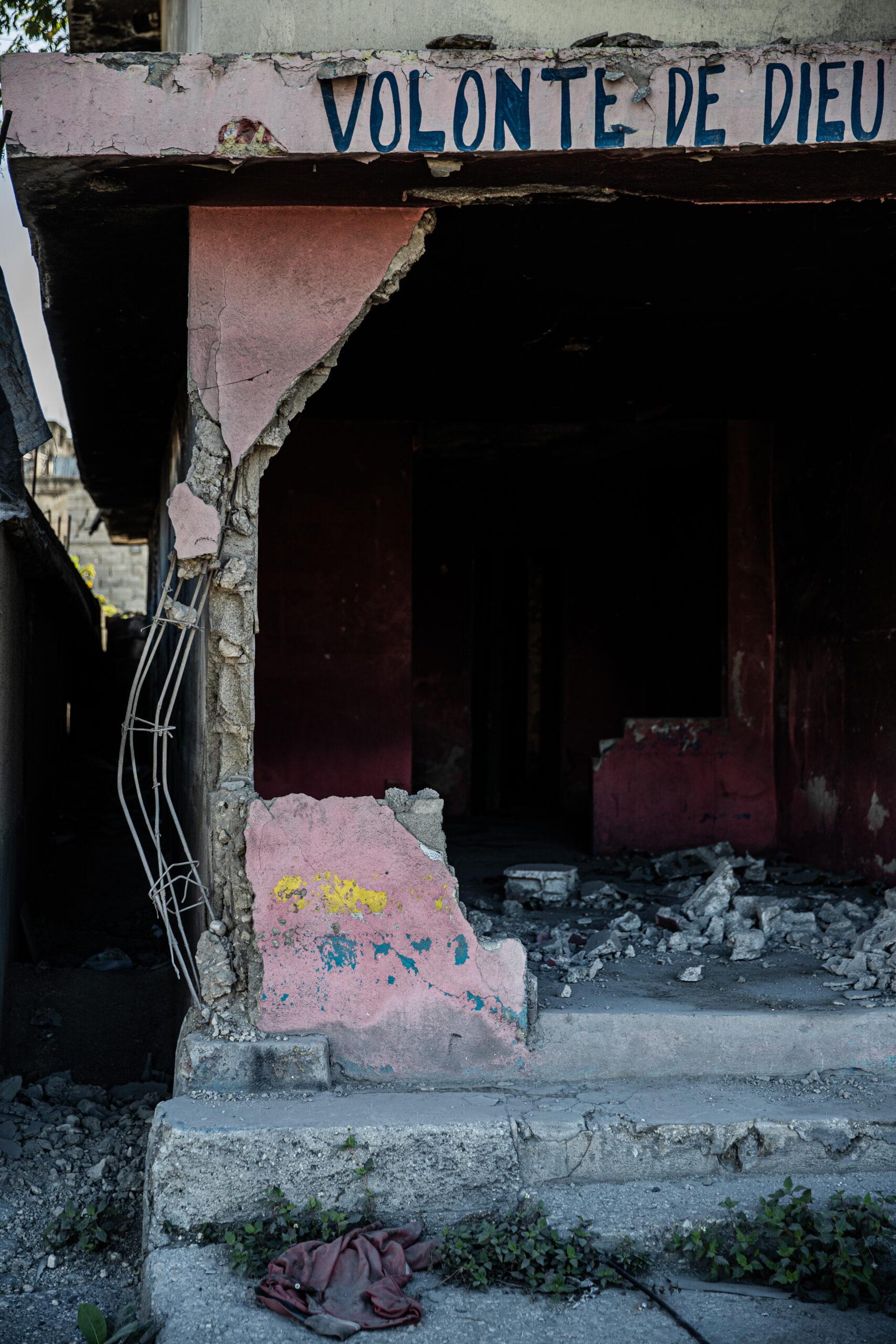
A house that was demolished by armed gangs in Bas-Delmas has « God’s Will » written on the wall.in Port-au Prince,Haiti,February 12,2026. Photo : Clarens Siffroy / GI-TOC
Ivander tries to talk to them. There is no way to talk to a mob; a mob is an animal without ears. They scream, furious, that they do not want whites there. They begin hitting us. The first machetes come out. Those who ran farther away from the explosion now rush back, perhaps drawn like magnets by the circle of people beginning to lynch us, or motivated by the desire to kill something. Now there are more of them. There are 60, 100, more. They are a mob. They are the fortress.
A man pulls us toward the kitchen. Another comes running with a bottle of gasoline spilling because it has no cap and says the most terrifying words, the words I have feared most: Bwa kale!
The sound of dozens of machetes being dragged across the pavement makes it impossible to hear anything else, and the pushing is already carrying us toward the corner of Rue 27, Bois Patate, in front of Tag Supermarket, the store that belonged to the Abraham family. It is like being in the sea; at times your feet cannot touch the ground. It is like being a leaf against the tide. Fighting back is no longer an option. If we start hitting them, we will only make it more painful, although perhaps faster.
Some voices try to calm the mob but only manage to slow them down. A very young man, wearing a blue shirt and a red bandana around his neck, gets us onto a motorcycle taxi and tells the driver to get us out of there. But they hit us and kick us off. One kick lands on my left leg, and I slam into the exhaust pipe at knee height. The pain makes me move more slowly.
The young man insists. No one hits him. He must be someone important. According to my calculations, he is not yet 18. The sound of the machetes combing the pavement sweeps away every thought and therefore every escape plan. The thought of ending up with a long black mane almost paralyzes me. They shout in my face, and in the droplets of saliva I recognize the smell of rum. Ivander no longer moves. He is pale, swaying with every shove and punch like a tree in the middle of a storm.
The young man with the bandana puts us back on the same motorcycle and orders the driver to get us out of there. Some stray stone continues to fall, but none hits its mark. My mouth is full of blood. The smell of gasoline and the sound of machetes against concrete slowly recede behind us.
They do not want whites here. They have had enough. They want to burn everything. Bwa kale!
Barbancourt Rum with the Owners of Fire
The leaders of the Brigade contact me the next day. They say they are sorry about the lynching. They also tell me that what happened was not right and that, had they known, they would have done something. I have spent weeks trying to speak with them, and only now, with half my body injured and the fire still in my head, they want to meet with me. I am contacted by Samuel Joasil’s cousin. His name is Franz. He is a major Brigade leader, a police officer, and the man who organizes the resistance in Pétion-Ville. I have been told about him as a formidable warrior whom the bandits fear for his violence and his strategic ability to hunt them down and turn them into dark stains on the floor of the kitchen.
He summons me to a small bar inside his territory. Ivander has organized the meeting and comes with me. We arrive after five in the afternoon. It is a truly tiny place, barely illuminated by a dim little yellow bulb. Time passes, darkness falls, and the tiny bulb gives off barely enough light for us to see each other’s faces. While we wait for the leader, we order two Barbancourts, the delicious Haitian rum created during colonial times. A bartender with thick glasses, thin, bald, and in his sixties, pours a generous stream into two glasses. The neighbors have already begun closing the streets with barricades in preparation for Viv Ansanm’s nighttime attacks. Franz does not appear.
Night falls and the bartender continue serving us rum. The smoke from our cigarettes fills the tiny bar with its tin walls, and my patience begins to run out. We are about to leave when the bartender sits down in front of me, extends a hand, and says, “Franz, enchanté.”
He is a solidly built man. He speaks with the ease of a politician and gestures expansively, passing long hands and pointed fingers in front of my face.
Our conversation proceeds slowly, and we have to speak through Ivander, who translates for us. He explains that the resistance inside the fortress may seem to operate according to chaotic logic, but in reality, it is very well organized. Every space has a leader, and that leader is responsible for organizing rotating groups to defend the “walls.” The quotation marks are necessary because there are no walls. In reality, it is piles of tires, large stones, and burned-out cars that they place every afternoon at the entrances to passageways and in the middle of the streets. Some days, when Viv Ansanm’s offensives are particularly strong, or when they receive information about imminent attacks, they close the streets all day and dozens of well-armed men take positions at the entrance to each neighborhood, checking everyone who comes and goes. When some part of the fortress is attacked, the help the others can provide is limited, because if everyone goes to one point, they weaken the others. Everything is learned through trial and error, and every mistake means one fewer neighborhood, more territory for the warlords.
Franz explains that Samuel Joasil, his cousin, is a high-ranking police officer and has contacts within police command. He says that when the bandits began eating their way through neighborhood after neighborhood, Samuel, some members of his family, and other associates organized all the police officers in this area. He appointed leaders, obtained weapons, and designed a collective system to defend themselves as a bloc. Franz explains that there are not enough weapons for everyone who has been organized, but that they have taught people to fight with machetes and make homemade weapons. He says the key is unity: a man who fights alone dies alone. Samuel designed an anthill.
Franz emphasizes the importance of Canapé Vert. He draws a map on the table with his finger and explains that to invade the entire fortress, they must first defeat Canapé Vert, then climb the steep slope of Debussy, guarded by another fierce police officer, a huge man known as Lelé, whom I unfortunately had the chance to meet when he himself, pistol in hand, detained me at a checkpoint during my first encounter with the Brigade.
Franz becomes grumpy when I ask him about Bwa kale. He tells me that all those dead people are gangsters, that people burn known criminals or people they find carrying weapons or trying to enter the fortress at night. He says it is strictly spontaneous.
“What will you do when the bandits reach here?” I ask him.
He tells me they will not get through, that they are strong.
I insist and remind him of the Solino neighborhood.
“People cannot run anymore. If we have to die, then we will die fighting,” he replies, showing me the .45-caliber pistol he carries on his belt.
Then he stands up with an energetic gesture. The conversation is over.
After March 15, when Viv Ansanm reached the borders of the fortress, Ivander has become a bundle of nerves. His plan to get his daughters out hidden among the sacks of a truck has failed. It was never a viable plan. Trucks remain for weeks in the ports, until the bandits give them permission to board the ferries, not before searching them thoroughly. One of his daughters is 19, and the other two are under ten. It would have been like sending a gift to the lord of the docks, King Micanor, the warlord who perpetrated one of the largest massacres in recent Caribbean history. It would have condemned them to a shitty world, a world worse than Port-au-Prince.
Ivander is not a drinker. He constantly boasts about his Christian faith. But on this day in late March, he asks me to buy him a bottle of wine at one of the few supermarkets still open in the fortress. “You fight better with wine in you, because it heats your head,” he tells me.
I invite him to lunch at a place with abundant food and cold beer to say goodbye. Bob Marley’s One Love is playing as loud as three speakers can manage.
“Let’s get together to fight this Holy Armageddon, one love..”
The patrons stare at the floor, lost. They barely take sips of their beers, and no one speaks to anyone else.
“So when the Man comes, there will be no, no doom, one song..”
Ivander lets out a sigh from time to time, and his facial tics contract his eyes. His mouth twists every 30 seconds.
“Have pity on those whose chances grows thinner.”
On one of my last nights in Port-au-Prince, at the beginning of April, the city plays its furious symphony of every early morning: gunshots, barking dogs, screams, more gunshots, gunshots all the time. But then something strange happens. An indecipherable commotion begins, like a rain of chaotic sounds, almost joyful.
I call Ivander. The noise is coming from the direction of his house. I can barely hear him; around him there is a strange kind of carnival. He manages to raise his voice enough to give me two words: “Bat tenéb.” It means “strike the darkness.”
The neighborhoods of Carrefour Feuilles are fighting, and, as Franz explained to me, the fortress brigades cannot go to their aid; they would leave their own territory unprotected. People strike the darkness with whatever they have: they shout, shouting encouragement to those who are resisting and at the bandits, so they know those who are fighting are not fighting alone. They shout so the bandits know that if they defeat them and get through, they will then have to defeat them too. They shout that they will not pass. They shout to drive away the darkness. People bang pots, launch fireworks into the sky, put stones in bottles and make them rattle. The dogs join in with the plaintive barking of stray dogs, and Carrefour Feuilles keeps fighting.
“Carrefour Feuilles will win!” They shout, and in doing so they break the darkness.
Carrefour Feuilles will lose, and then other neighborhoods will shout at night to encourage Monoville, Canapé Vert, Pétion-Ville, Debussy, or whatever remains of Delmas. The city is already dead, but it does not know it.
The fortress is attacked every night. It is surrounded.
These days Samuel appears in public at a large event, wearing a necklace of bullets around his neck and promising to retake Port-au-Prince through fire and bullets, becoming one more of the warlords fighting for the city.
The city has already fallen. What remains is a corpse.
The consequences of the barbarity have even broken the magic of the Hotel Karibe. On March 24, Viv Ansanm men amuse themselves playing with the corpse of Benedict Kabiru, a Kenyan police officer from the international mission, in the Artibonite region, 100 kilometers from Port-au-Prince. The great gang confederation has defeated a mixed convoy of Kenyan and Haitian police using simple guerrilla tactics, and they make videos putting on the uniforms of the dead officers. One of the bandits looks at the camera and says he will eat the bodies, while another does not stop slapping Kabiru’s corpse. In the background, two armored vehicles illuminate everything with their flames.
From that day on, the apathetic faces of the guests at The Karibe have become faces of defeat and fear, and the hotel has also become a kind of airport. In a lot behind the hotel, a United Nations helicopter lands and takes off at least three times a day. Dozens of people wait for a place, carrying suitcases, while having a drink at the hotel’s outdoor bar.
I have been trying to arrange my departure for a week, but since March 7, the day the operation to kill Barbecue failed, Monsieur X has not answered my phone, nor has the police chief or the prime minister’s office. The people at the United Nations refuse me a place on their helicopter because I am not part of the organization. I escape when my wife, Sarah, and José Luis Pardo, editorial director of Dromómanos and my editor, secure me a seat on a private helicopter to Cap-Haïtien. From there, I head home, crossing a rosary of Caribbean islands before arriving in Miami.
Before leaving, I say goodbye to Ivander and ask him one of the cruelest questions I have ever had to ask in my career:
“What are you going to do when the bandits reach your house?”
Ivander does not look me in the eyes and does something very strange: he smiles sadly.
Then he gives me a short answer:
“Drink wine.”
By : Juan Martínez D’aubuisson
Cover | A school destroyed by armed gangs in a street of the Solino neighborhood of Port-au-Prince, Haiti,on February 17, 2026 which was attacked by gang fighters in late 2024. Photo : Clarens Siffroy / GI-TOC
► AyiboPost is dedicated to providing accurate information. If you notice any mistake or error, please inform us at the following address : hey@ayibopost.com
Keep in touch with AyiboPost via:
► Our Channel Telegram : Click here
► Our Channel WhatsApp : Click here
► Our Community WhatsApp : Click here

Comments