
The school of a juvenile detention center in Haiti has achieved an almost perfect pass rate on official 9th-grade exams for around fifteen years. The minors, some of whom are suspected of crimes, are calling for the opportunity to continue their studies
The elementary school of the Center for the Rehabilitation of Minors in Conflict with the Law has, for about fifteen years, maintained a near-perfect success rate in Haiti’s official Ninth Fundamental Year exams.
According to official records from the past decade at CERMICOL reviewed by AyiboPost, 60 incarcerated minors at the center took part in these national exams. Fifty-five passed, while only five failed.
For the academic years 2020–2021 and 2022–2023, the success rate was 100 percent. A trend that has continued for at least fifteen years, according to two officials from support organizations and two teachers at the institution in Delmas 33.
The perseverance of these children, some of whom are detained on suspicion of serious crimes, inspires pride.
“It is a good thing,” Jude Chéry, president of the Association of Volunteers for the Reintegration of Detainees in Haiti, told AyiboPost. “It shows that a bridge toward the future is being built through rehabilitation aimed at reintegration.”
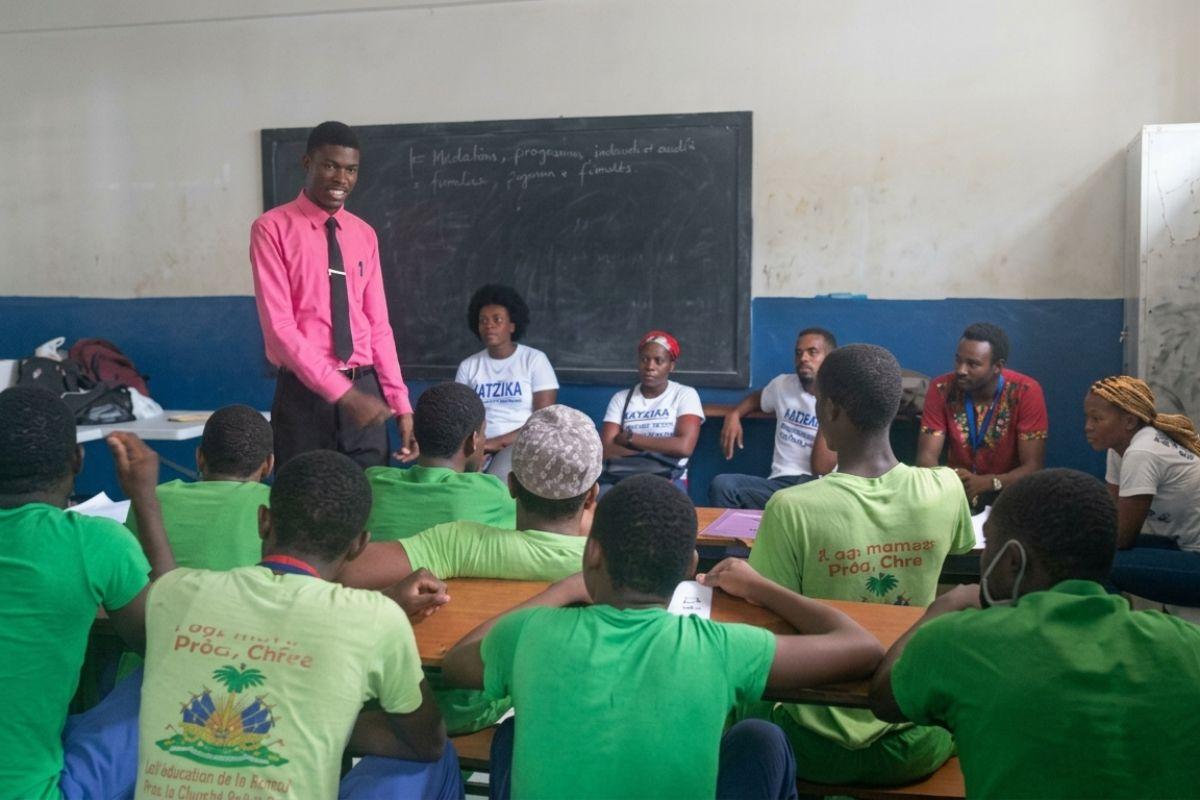
Young inmates at the CERMICOL training center. Photo credit: Katizana.
The organization where Chéry works, AVRED-Haiti, has been involved since 2019 in vocational training for the center’s young detainees. Their continued academic achievement comes in a context where the country’s prison centers operate with meager budgets and face structural challenges that weaken detention conditions.
On Wednesday, April 9, 2026, constant movement filled the CERMICOL compound under the midday sun: police officers, organization officials, and detainees moved about, while some prisoners spoke with relatives who had come to visit them through the gates.
In the back courtyard of the building, crushed by intense heat, members of humanitarian organizations were busy around three large blackened cauldrons scorched by flames, used for steaming food, partly hidden behind a curtain of faded tarps.
A few meters from this preparation, which drew the attention of many detainees, Joseph L., the center’s top student for the 2024–2025 academic year, sat on a bench facing a crumbling wall.
With 2,074 points out of a total of 2,700, Joseph L. was one of six out of seven minors who passed the latest official exams.
At seventeen years old, he told AyiboPost that he was arrested by the Haitian National Police in the Pernier area, a suburb of Port-au-Prince, during the first half of 2022 on suspicion of murder and kidnapping. He was only thirteen at the time.
Joseph L. is still awaiting his hearing before a judge. While he waits, he has turned education into a true lifeline.
“When you are in prison, people often tend to believe you are lost forever and that nothing good can come from you. Through my results, I think I helped break that ‘myth,’” he explained to AyiboPost.
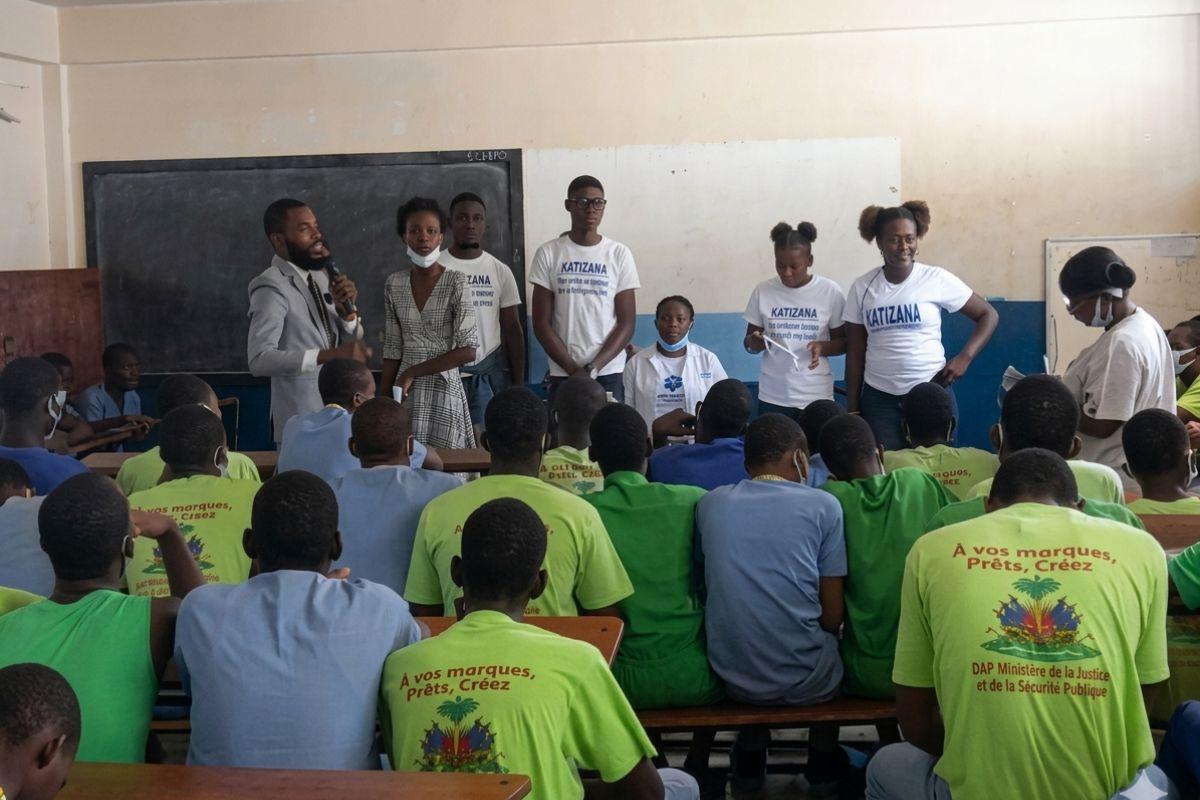
Young inmates at the CERMICOL training center. Photo credit: Katizana.
Speaking clearly and thoughtfully, Joseph L. said his success was not achieved without hardship.
“The noise or the fights [inside the center] can easily distract you,” he said.
The teenager recalls a violent brawl between detainees that broke out in his cell on the eve of the official 9th-grade exams.
“That night, I could not review my notes. If it had not been for that incident, I could have scored many more points.”
Praised by one of his teachers to AyiboPost for “his dedication to study” and his “intellectual abilities,” Joseph L. received a digital tablet as a gift from the Minister of Justice after the exams. He says he can use it during his free time.
Other detained minors are also walking the path of academic excellence.
Julien P., on the threshold of his twenties, was the center’s second-ranked student for the 2024–2025 academic year, with a total of 1,770 points.
After being arrested in Pétion-Ville five years ago on allegations of criminal conspiracy and armed robbery, this young man, whose mother died in 2016, was placed at CERMICOL. He joined the center’s school starting in the 6th fundamental year.
While he acknowledged to AyiboPost that the experience of the correctional center has benefited him through self-reflection and the thinking he has been able to do behind bars about his past “questionable” associations, he denounced his situation of prolonged pretrial detention.
“I should already be free,” Julien said, visibly upset. “A judge heard my case and issued a release order in my favor in December 2025. But it has never been carried out.”
Inaugurated on October 30, 2005, CERMICOL is one of around twenty facilities that make up Haiti’s prison system.
The institution falls under the Directorate of Prison Administration, the body responsible for overseeing all penitentiary centers in the country.
The center provides academic instruction for minors focused exclusively on the fundamental school levels (from 1st to 9th year). Classes run from eight in the morning until one in the afternoon and cover the same subjects taught in the country’s formal schools.
Teachers recruited by the Haitian state provide the lessons.
Designed to house around one hundred detained children, CERMICOL is now overcrowded after the arrival of detainees transferred from the National Penitentiary and the Croix-des-Bouquets prison, both destroyed by gangs in March 2024.
A report published on March 9, 2026, by the National Human Rights Defense Network raised concerns about degrading detention conditions inside the center, as well as the scourge of prolonged pretrial detention affecting nearly all prisoners.
The report denounced the gradual transformation of the facility into a true penitentiary administrative complex where, in shocking overcrowding, 719 detainees now live together: 475 men, 142 women, and 87 minor boys — in violation of international conventions ratified by Haiti regarding juvenile detention conditions.
Only 23 of these detainees had been convicted, representing around 3 percent.
This prison overcrowding, attributed to “a failure of the Haitian judicial system,” moves the center further each day from its original mission of rehabilitation and weakens its educational component.
Jude Chéry of AVRED had already noted, in an AyiboPost article in June 2024, the shrinking of spaces dedicated to minors’ activities, with only two classrooms available out of nine previously, in a work environment that had become “noisy” and with limited logistical means.
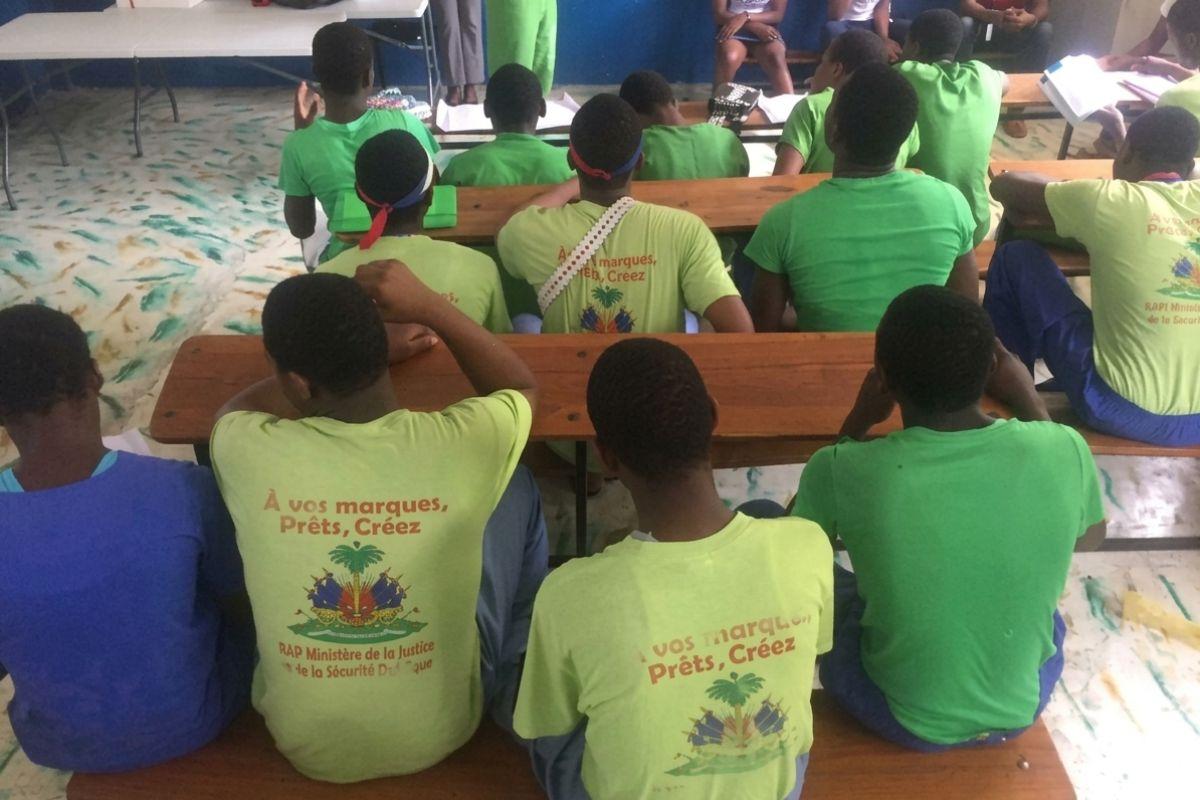
Young inmates at the CERMICOL training center. Photo credit: Katizana.
Yet despite these challenges, bringing the bread of education to these detainees is, for teachers, sometimes a calling.
Esdras Bon-Ami joined the school in the aftermath of the 2010 earthquake. He quickly grew attached to the profession, seeing it as a concrete way to reshape the life paths of these young detainees, far from violence or “socially condemned behavior.”
“In this work, I have met children who are intellectually alert. Sometimes one even wonders how minds so bright ended up in a prison center,” the teacher said.
The quality of teaching and discipline are among management’s priorities.
“They are direct delegates of the Ministry of Education who supervise the official exams each year, in accordance with established standards,” Bon-Ami revealed. “There are neither favors nor mitigating circumstances for detainees.”
Despite clear academic success, the educational program stops at the 9th grade — a break in continuity that slows the momentum of detained students who are demanding the chance to continue their studies.
Jude Chéry said he carried out advocacy efforts, notably in 2022, with the Directorate of Prison Administration to extend the curriculum.
But according to Chéry, the central prison administration opposed the project because of insufficient funding, lack of adequate infrastructure able to host the four additional secondary-school grades, and a shortage of teachers to cover the new subjects.
By: Junior Legrand
Cover | CERMICOL, Port-au-Prince, May 2, 2019. Children at the Rehabilitation Center for Minors in Conflict with the Law (CERMICOL) in Port-au-Prince. Photo: MINIJUSTHUN
► AyiboPost is dedicated to providing accurate information. If you notice any mistake or error, please inform us at the following address : hey@ayibopost.com
Keep in touch with AyiboPost via:
► Our channel Telegram : Click here
►Notre Channel WhatsApp : Click here
►Our Community WhatsApp : Click here





Comments